Insights
November 29, 2025
Ultimate Coaching Workflow Template for New Hire Onboarding with AI (2025 Guide)

Varun Arora
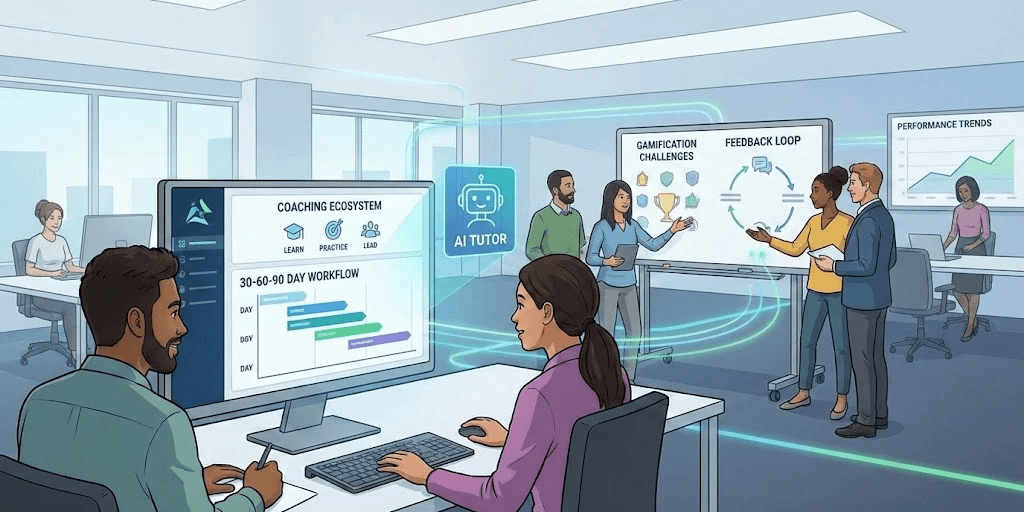
Onboarding customer support talent is no longer a back-office function—it’s a frontline strategy. With customer experience now acting as a brand’s strongest competitive differentiator, organizations must transform onboarding from a checklist into a strategic coaching ecosystem.
Research shows new hires are 3x more likely to succeed with structured coaching, especially when tied to a 30-60-90 day workflow.
In this guide, we walk you through a fully integrated, AI-enhanced onboarding system that embeds all core strategies—gamification, feedback loops, KPI tracking, shadowing, and skill development—inside the three foundational phases.
PHASE I: DAYS 1–30 - LEARN, ABSORB & BUILD CONFIDENCE
The first 30 days of coaching new hires for support and ramping up support reps' focus on psychological safety, cultural assimilation, and foundational skill-building. The goal isn’t productivity—it’s confidence, clarity, and competence.
According to research, new hires in this phase must focus on:
Cultural alignment
Tool proficiency
Relationship building
Low-pressure practice wins
1. Learning Foundations Through Structured Onboarding
New hires absorb:
Product knowledge
Policies & playbooks
Customer persona training
Support systems (CRM, helpdesk, AI copilots)
The biggest risk here is knowledge debt—when new hires skip fundamentals and struggle in later phases.
2. AI-Enhanced Learning & Pre-Boarding
Artificial intelligence plays a major role in making early onboarding smooth and efficient.
AI can provide:
Personalized onboarding task lists
Automated setup of accounts & tools
AI tutors that explain policies conversationally
Knowledge copilots that answer questions instantly
Micro-learning modules tailored to the learning pace
This reduces “Day 1 friction,” which the research identifies as a major blocker to early confidence.
3. Gamification to Boost Engagement
Gamification gives new hires a low-pressure way to explore the organization, increasing retention and social confidence.
Examples:
Onboarding Bingo ✦ Encourages completing small but meaningful tasks
Scavenger Hunts ✦ Strengthen tool exploration & cultural discovery
These activities are especially effective in remote teams, reducing isolation and accelerating peer connections.
AI-Enhanced Gamification
AI can automatically:
Generate custom Bingo cards
Track completion metrics
Adjust challenges based on performance
Deliver personalized nudges
4. Shadowing & Active Observation
Shadowing is essential in Phase I, but the research emphasizes active shadowing—not passive watching.
New hires observe:
Tone and de-escalation
Query troubleshooting
CRM workflows
How senior agents use KB articles in real time
AI Support During Shadowing
AI tools can:
Produce call summaries
Highlight best-practice moments
Show knowledge articles referenced during calls
Provide sentiment analysis
This creates a richer learning environment and accelerates comprehension.
PHASE II: DAYS 31–60 - INTEGRATE, PRACTICE & APPLY SKILLS
This is the “ramping” stage—the moment new hires transition from learning to doing. According to the research doc, this phase converts theoretical knowledge into kinetic behavioral skill.
1. Beginning Live Work With Guardrails
New hires now:
Handle low-risk queues (e.g., email)
Participate in guided ticket ownership
Use playbooks to solve real customer issues
Productivity targets rise to 50–75%, but accuracy is still more important than speed.
2. Reverse Shadowing: The Proficiency Accelerator
One of the strongest techniques from the research document is reverse shadowing.
Instead of watching, the new hire drives the interaction while the experienced agent observes.
This dramatically boosts:
Self-efficacy
Real-world problem-solving
Tool confidence
Decision-making skills
Coach’s Role in Reverse Shadowing
Use Socratic prompts such as:
“What resource could help you take the next step?”
“How would you explain this to a friend?”
“What’s the customer’s emotional state right now?”
3. AI-Powered Real-Time Assistance
AI significantly accelerates performance in Phase II by offering:
Real-time writing suggestions
Auto-detected sentiment cues
Smart routing recommendations
Error prevention alerts
Playbook suggestions based on intent
This reduces stress and improves accuracy.
4. Feedback Loop: Ask–Tell–Ask Model
Coaching must shift from instructional to corrective-developmental.
The research highlights the Ask-Tell-Ask structure as the ideal feedback model:
✔ Ask — Let the rep assess their own performance
✔ Tell — Provide objective feedback with data
✔ Ask — Co-create next steps and action items
AI in the Feedback Loop
AI can produce:
Weekly coaching packets
Ticket review summaries
QA scoring with time stamps
Script adherence feedback
This saves leaders hours every week.
5. Metrics That Matter in Phase II
Key metrics to track:
QA Score (target: >80%)
CSAT (target: >4.0)
AHT (team avg + 50%)
FCR (>60%)
Escalation rate (declining trend)
These numbers ensure new hires progress at a healthy and realistic pace.
PHASE III: DAYS 61–90 - LEAD, OPTIMIZE & ACHIEVE AUTONOMY
In the final phase of coaching new hire for support, onboarding CX hires, ramping up support reps, the rep transitions from learner to contributor. This is where mastery, autonomy, and consistency emerge.
The research calls this stage “Lead & Optimize”—new hires become net contributors.
1. Full Queue Ownership
New hires now:
Handle complex cases
Navigate edge scenarios
Solve problems without constant help
Hit 90–100% productivity benchmarks
Confidence turns into momentum.
2. Advanced Coaching & Skill Maturity
Coaching shifts from “fixing errors” to:
Strengthening emotional intelligence
Improving productivity & accuracy
Identifying specialization opportunities
Preparing reps for future leadership
3. AI-Assisted Optimization
AI is most powerful in Phase III because reps now understand the ecosystem.
AI can deliver:
Performance trend analysis
Personalized skill-gap insights
Automated suggestions for improvement
Comparative analysis with top performers
This helps new hires break plateau points faster.
4. Metrics for Full Proficiency
Final-phase KPI benchmarks include:
CSAT > 4.5
QA Score > 85–90%
AHT at the team average
FCR > 70%
Escalations <5%
(These align with the research doc’s proficiency targets.)
5. Continued Growth: Gamification, Cross-Training & Peer Leadership
Even at this advanced stage, engagement matters.
This phase often includes:
Advanced gamification challenges
Cross-training opportunities
Mentorship of new hires
Contribution to playbook improvements
According to the research, agents in this phase should start proposing process improvements and documenting learnings for future cohorts.
FAQs
1. How long does it take to fully ramp up a support rep?
Most organizations follow a structured 90-day plan for full proficiency.
2. How does AI make onboarding more effective?
AI reduces manual coaching time, enhances knowledge access, automates QA, and enables personalized learning.
3. When should reverse shadowing be introduced?
Typically during Weeks 3–4 when new hires have mastered basic navigation.
4. What’s the best way to deliver feedback to new hires?
The Ask-Tell-Ask method improves psychological safety and ownership of growth.
5. What metrics define successful onboarding?
Key KPIs include QA score, CSAT, FCR, AHT, and escalation rate.
6. How can you keep new hires engaged during onboarding?
Gamification, structured coaching, and AI-guided learning increase engagement and memory retention.
Conclusion
A world-class onboarding program blends structure, coaching, and technology into one seamless experience. By applying the 30-60-90 framework—and embedding reverse shadowing, gamification, KPI tracking, and continuous feedback—companies can dramatically improve success rates when coaching new hire for support, onboarding CX hires, ramping up support reps.
AI enhances every phase: simplifying early learning, guiding mid-stage performance, and accelerating final-stage optimization. The result? Confident, capable, high-performing CX professionals who deliver an exceptional customer experience.