Insights
February 4, 2026
The Hidden Cost of Missed Follow-Ups in Customer Support (And How AI Is Fixing It)

Varun Arora
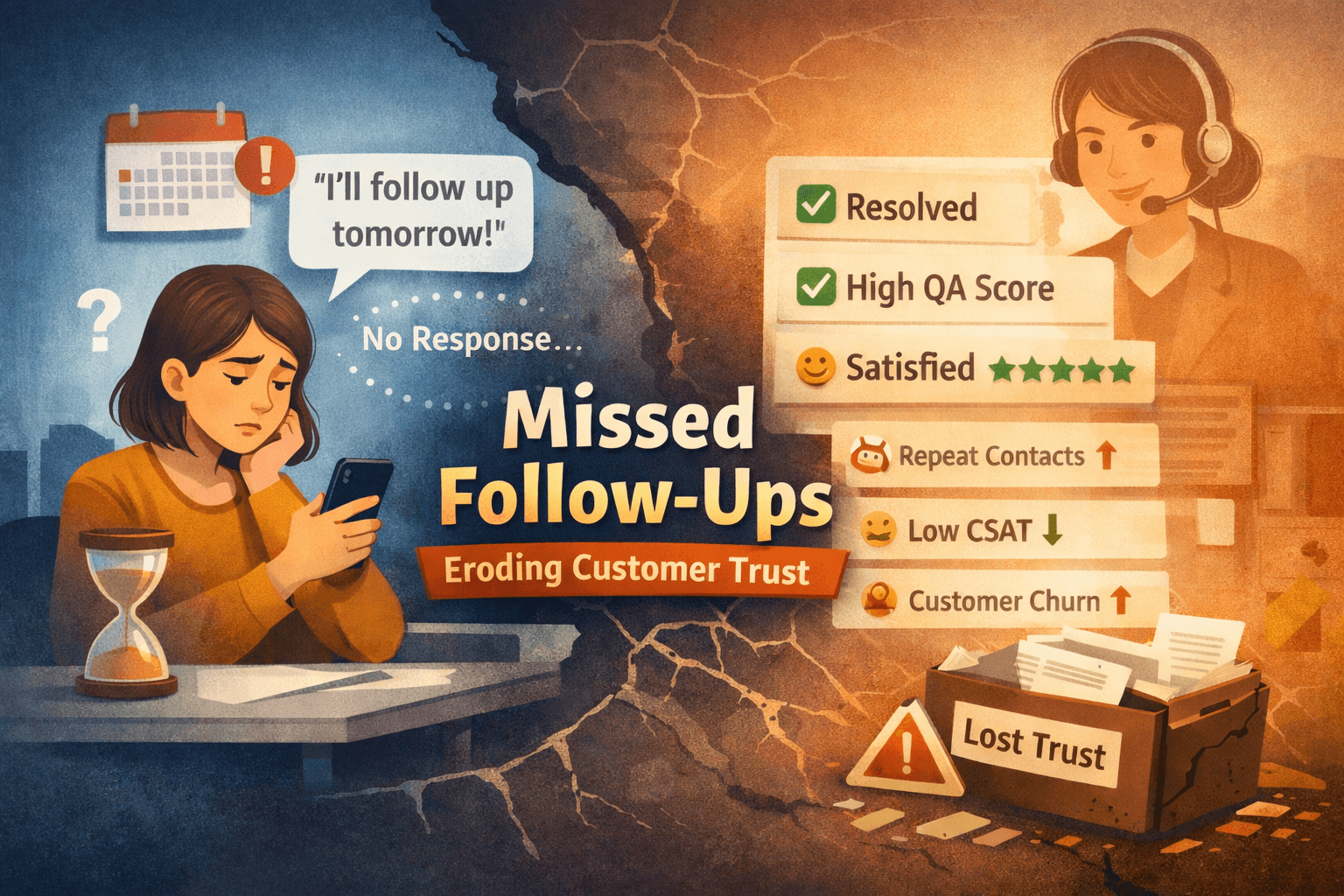
Customer support teams don’t usually fail because agents are rude or untrained. Most failures happen after a good conversation when a promised follow-up slips through the cracks.
An agent says, “I’ll get back to you in 24 hours.”
The agent marks the ticket as resolved
or keeps it open and tags it for next steps.
And then… nothing.
Traditional conversation analytics tools proudly say they audit every conversation. But here’s the uncomfortable truth: auditing everything is not the same as auditing what matters.
This is where a smarter, context-aware approach to AI quality assurance changes the game.
Why Missed Follow-Ups Are a Silent CX Killer
Missed follow-ups rarely explode into obvious problems. There’s no angry chat transcript. No escalation in real time. No clear signal that something went wrong.
And that’s exactly why they’re so dangerous.
From the customer’s point of view, the experience felt right—until it didn’t. The agent was polite. The issue was understood. A follow-up was promised. Trust was established.
Then the silence starts.
Silence After a Promise Feels Personal
When a customer is told, “I’ll get back to you by tomorrow,” they’re not just hearing a timeline; they’re hearing a commitment. Once that commitment is missed, the problem shifts from a product issue to a trust issue.
Customers rarely chase immediately. They wait. They assume the system is working. And when nothing happens, the feeling isn’t frustration, it’s disappointment.
By the time they reach out again, they’re already less patient and far less forgiving.
Missed Follow-Ups Don’t Trigger Alerts. They Erode Trust
Unlike long wait times or unresolved tickets, missed follow-ups don’t create operational red flags. The ticket often looks “resolved.” The conversation reads well. The QA score looks fine.
But underneath, trust is quietly leaking.
This erosion shows up later as:
Lower CSAT with no clear root cause
Repeat contacts for the same issue
Customers escalating faster the next time
Increased churn that feels “unexplained”
The damage happens after the conversation—outside the reach of traditional QA.
The Most Costly CX Failures Are the Ones You Don’t See
What makes missed follow-ups especially harmful is that they often go unnoticed. Teams assume follow-ups are happening because there’s no system proving they aren’t.
Without visibility, there’s no accountability. Without accountability, the behavior repeats.
And over time, customers learn one thing:
Promises made by support don’t always mean promises kept.
That perception is far more damaging than a slow reply—and far harder to recover from.
The Fundamental Problem With Traditional Conversation Audits
Most conversation analytics platforms work like this:
Every ticket is pushed to AI
The conversation is analyzed once
A quality score is generated
The ticket is now in the past
What’s missing? Context over time.
If an agent promises a follow-up:
The promise happens in conversation #1
The action (or inaction) happens hours or days later
Yet the audit happens immediately- before the outcome is even known.
That’s like grading a movie halfway through.
Why “Audit Everything” Completely Breaks When It Comes to Follow-Ups
On paper, auditing every conversation sounds like the safest approach. In reality, it fundamentally fails when follow-ups are involved. Follow-ups are not single moments; they’re commitments that play out over time. And that’s exactly where traditional “audit everything” models fall apart.
1. Follow-Ups Can’t Be Evaluated at the Moment of Conversation
Most audits happen immediately after a ticket is closed or a conversation ends. But follow-ups, by definition, are supposed to happen later.
Auditing too early means the system can only evaluate what was said, not what was done. As a result, tickets get scored before the follow-up window even expires, making it impossible to know whether the promise was fulfilled.
2. Auditing Everything Ignores Which Tickets Actually Need Follow-Up
Not every conversation requires a follow-up. Yet traditional systems treat all tickets the same.
Tickets where a follow-up was promised aren’t treated any differently from tickets that don't require follow-ups.
Without understanding intent and context, the system has no way to prioritize tickets where follow-ups truly matter- so the most critical gaps remain hidden.
3. Once a Ticket Is Scored, There’s No Way Back
In most QA workflows, a ticket is analyzed once and then archived. Even if a follow-up was promised for 24 or 48 hours later, there’s no mechanism to return to that ticket and reassess it based on what actually happened.
This one-and-done scoring model creates a false sense of quality, where tickets appear compliant even when promised actions were never taken.
The result: broken follow-ups don’t show up as failures- they simply disappear from visibility.
What Smarter QA Looks Like: Auditing With Intent
Modern AI-driven QA systems are shifting from volume-based audits to intent-based audits.
Instead of asking:
“Did the agent say the right thing?”
They now ask:
“Did the agent do what they said they would do?”
This requires three capabilities:
Understanding conversational context
Detecting promised or required follow-ups or actions
Waiting for the correct amount of time before scoring
That’s where intelligent ticket screening becomes essential.
How AI Can Identify Follow-Ups Before Auditing
The breakthrough isn’t auditing better- it’s deciding what to audit and when.
A smarter system should first screen tickets to understand:
Was a follow-up required by SOP?
Did the agent explicitly promise a follow-up?
Was a timeframe mentioned (e.g., 24 hours, end of day, 48 hours)?
Only when the answer is yes does the system intervene.
This approach eliminates unnecessary audits and focuses QA exactly where risk exists.
Timing Is Everything: Why Delayed Audits Matter
If a follow-up is promised in 48 hours, auditing the ticket immediately is pointless.
A context-aware AI screener:
Detects the promise
Pauses the audit process
Waits for the specified duration
Checks whether the follow-up actually happened
Only then does it analyze and score the ticket, with the outcome included.
This turns QA from a static snapshot into a full lifecycle evaluation.
What Teams Can Finally Measure (That They Couldn’t Before)
With follow-up-aware auditing, support leaders can now answer questions that were previously invisible:
How many follow-ups were promised vs. completed?
Which agents consistently miss follow-ups?
Where do SOP-defined follow-ups break down?
How often are customers left waiting past promised timelines?
These insights don’t just improve QA scores- they improve customer trust.
The Operational Benefits Go Beyond QA
For Support Managers
Clear visibility into accountability gaps
Fewer escalations caused by broken promises
For QA Teams
Focus on high-risk tickets only
More meaningful quality scores
For Customers
Fewer repeat contacts
Higher confidence in agent commitments
For Leadership
Data-backed proof of process adherence
Stronger correlation between QA and CSAT
Why This Matters Now More Than Ever
Customers today don’t judge support by friendliness alone. They judge it by follow-through.
In a world of instant communication:
A missed follow-up feels intentional
Silence feels like neglect
Broken promises cost more than slow replies
AI that understands what was said and what happened next is no longer optional—it’s essential.
Frequently Asked Questions (FAQs)
1. Why can’t traditional QA catch missed follow-ups?
Because most systems audit tickets only once, immediately after the conversation ends—before any follow-up action occurs.
2. Aren’t follow-ups tracked manually today?
Yes, but manual tracking doesn’t scale and often relies on agents updating tickets correctly, which is inconsistent.
3. How does AI know a follow-up was promised?
By analyzing conversational context, agent language, and SOP requirements within the conversation itself.
4. What if the follow-up time isn’t explicit?
Advanced systems infer timing based on SOP rules or standard operational expectations.
5. Does this increase audit volume?
No. It reduces unnecessary audits and focuses only on tickets that genuinely require follow-up validation.
6. How does this improve customer satisfaction?
Customers experience fewer broken promises, faster resolutions, and more reliable communication.
Final Thoughts: QA That Reflects Reality, Not Assumptions
Auditing conversations without checking outcomes creates a dangerous illusion of quality.
True quality assurance doesn’t ask:
“Did the agent sound good?”
It asks:
“Did the customer get what they were promised?”
By screening tickets intelligently, waiting when necessary, and scoring only when the full story is known, modern AI-driven QA finally closes the follow-up gap.
And in customer support, closing the loop is everything.