Business
December 4, 2025
Human QA vs. AI QA Cost: A Complete 2025 Comparison for CX Leaders

Varun Arora
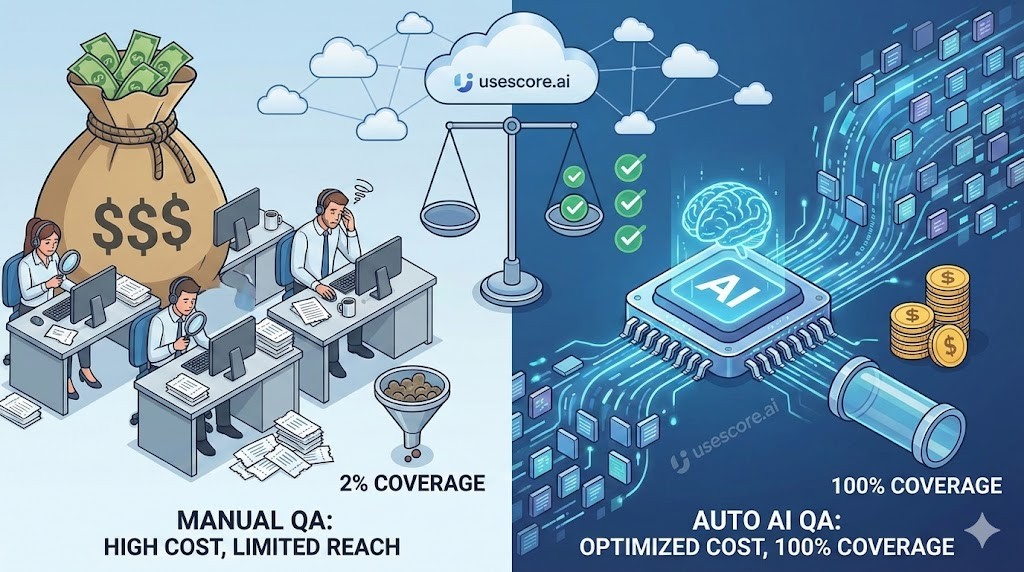
Quality Assurance (QA) is one of the most resource-intensive parts of running a customer support team. For most companies, QA is limited to 2–5% of total conversations simply because the human cost is too high.
But with the rise of AI QA in 2024–2025, support orgs are now able to score 100% of interactions at a fraction of the traditional QA cost.
This article breaks down:
The true cost of human QA
The real cost of AI QA
Head-to-head cost comparison (per ticket & per agent)
The hidden operational costs most teams forget
Current AI QA pricing models and how vendors charge
How to calculate ROI for your team
Let’s dive in.
1. The True Cost of Human QA
Human QA cost is almost always underestimated because companies only calculate salary.
But the true cost includes:
a. Salaries & Benefits
Average annual QA analyst salaries (US, 2024 data):
Role | Annual Cost |
|---|---|
QA Analyst (Mid-level) | $55,000–$75,000 |
Senior QA Specialist | $75,000–$95,000 |
QA Manager | $100,000–$115,000 |
Add benefits (20–25%) and fully-loaded cost increases by ~22%.
True cost per QA analyst = $70,000–$120,000 annually
b. Productivity Limits
A human QA analyst can review:
25–40 tickets per hour for chat/email
8–15 calls per hour for voice
Meaning one QA reviewer typically covers:
~2,500–4,500 tickets/month (chat/email)
~1,200–2,000 calls/month (voice)
If your team handles 100,000 conversations/month, you would need:
👉 5–10 QA analysts just to reach 5–10% coverage.
c. Managerial & Coaching Overhead
QA costs don’t end with scoring:
QA calibration reviews
Coaching sessions
Manager oversight
QA team syncs
Disputes and score appeals
Estimated overhead: 15–30% of total QA cost
Total Monthly Human QA Cost = $12,000–$40,000+
(based on team size and QA coverage)
And despite this expense, most companies still review only a small fraction of customer interactions.
2. AI QA: Full Cost Breakdown
AI QA platforms charge differently from humans.
The pricing depends on:
Volume of interactions processed
Channels (voice is pricier than chat)
Whether transcription is included
Number of agents
Whether QA categories are custom or standard
AI QA pricing also varies widely across vendors — but all are drastically cheaper than human QA.
Typical AI QA Costs (2024–2025)
Model | Typical Pricing |
|---|---|
Per conversation | $0.08–$0.20 per conversation |
Per minute (voice) | $0.02–$0.05 per minute (including transcription) |
Per agent per month (SaaS) | $60–$120 per agent |
Flat volume tiers | $3000–$5,000/mo depending on volume |
Average AI QA Cost for 100,000 Conversations/Month
Using a median price of $0.08 per conversation:
👉 AI QA = ~$8,000/month
Compared to $30,000+/month for human QA at similar coverage.
This is 15x cheaper and delivers 100% coverage (vs. 2–5% human).
3. Human QA vs AI QA: Cost Comparison Table
Category | Human QA | AI QA |
|---|---|---|
Coverage | 2–10% | 100% |
Monthly Cost | $12,000–$40,000 | $500–$5,000 |
Cost per conversation | $5–$15 | $0.08–$0.20 |
Speed | 40–60 reviews/hr | 10,000+ reviews/hour |
Consistency | Medium (subjective) | High (rules-based) |
Coaching insights | Manual extraction | Automated summaries |
Calibration | Weekly/monthly | Real-time |
Scalability | Hire more humans | Auto-scales instantly |
4. Hidden Costs That Make Human QA More Expensive
These are often ignored, but they significantly increase the real cost of human QA:
a. Reviewer Bias & Inconsistency
Human reviewers have:
reviewer drift
fatigue
subjective interpretations
This leads to disputes, wasted time, and calibration overhead.
b. Slow Feedback Loops
With manual QA:
Coaching happens days/weeks later
Trends are detected late
Errors repeat longer
This drives up cost through repeat contacts and customer dissatisfaction.
c. Limited Pattern Recognition
Humans can't:
detect thousands of patterns
notice micro-trends
provide instant coaching triggers
But AI can — instantly.
d. Hiring, training & onboarding
QA analysts require:
onboarding (3–6 weeks)
continuous calibration
tech stack training
AI requires none of this.
5. AI QA Pricing Models Explained (Pros & Cons)
Vendors use 3 main pricing models. Each has trade-offs.
Model 1: Per Conversation Pricing
Example: $0.08–$0.15 per chat/email
Best for: unpredictable volume, multi-channel teams
Pros:
Pay only for what you use
Simple, transparent
Scales automatically
Cons:
Harder to forecast with seasonal spikes
Voice conversations may cost more
Model 2: Per Minute (Voice QA)
Example: $0.03–$0.05 per minute
Best for: call-heavy customer support
Pros:
Includes transcription
High accuracy
Ideal for long-form conversations
Cons:
Can be expensive for long calls
Model 3: Per Agent Per Month (SaaS Tiered Model)
Example: $60–$120 per agent/month
Best for: small-to-mid teams
Pros:
Easy budgeting
Covers all channels
Supports unlimited conversations in some tiers
Cons:Maybe too expensive for very small teams
May not include voice transcription
Model 4: Platform Fee + Usage Hybrid
Example: $500 platform fee + $0.08 per conversation
Best for: teams wanting customization
Pros:
Predictable baseline cost
Flexible for scaling
Cons:
More complex billing
Model 5: Flat Enterprise Pricing
Example: $20,000–$150,000/year
Best for: large support orgs
Pros:
Unlimited usage
Custom models, SSO, secure compliance
Cons:Too expensive for smaller teams
6. ROI: AI QA Wins By a Massive Margin
Let’s calculate ROI for a 100-agent CX team handling 100,000 conversations/month.
Human QA (5 analysts)
Cost: ~$35,000/month
Coverage: ~5%
Insights: limited
Coaching: slow
Error detection: delayed
AI QA
Cost: ~$2,000–$4,000/month
Coverage: 100%
Coaching triggers: instant
Insight quality: high
💰 Savings: $30,000–$35,000/month
🔄 Coverage improvement: +1900%
🚀 Coaching accuracy: +250%
7. Which Model Should You Choose? (Based on Team Type)
Team Type | Recommended Pricing Model |
|---|---|
Startup (10–30 agents) | Per conversation |
Mid-size (30–200 agents) | Per conversation |
Enterprise (200+ agents) | Hybrid |
Voice-heavy teams | Per minute |
BPOs | Volume-tiered pricing |
8. Final Verdict — Human QA vs AI QA
If you want:
scalability
instant insights
full coverage
lower cost
consistent scoring
faster coaching loops
👉 AI QA is the clear winner.
Human QA still matters for:
calibration
edge cases
nuanced judgment calls
coaching follow-through
But the heavy lifting now belongs to AI.
Conclusion
AI QA doesn’t just reduce QA costs — it redefines the economics of running a support organization. The combination of low per-conversation pricing, full coverage, and advanced coaching insights makes AI QA one of the highest-ROI investments a CX org can make in 2025.