Insights
February 16, 2026
How to Reduce Agent Onboarding Time with AI-Driven Roleplays

Varun Arora
Customer experience teams today are under more pressure than ever. Rising customer expectations. Increasing ticket complexity. High agent turnover. And limited time for meaningful coaching.
The "sink or swim" method of training customer experience (CX) agents is a gamble that most modern brands can no longer afford to take.
When a new hire is thrown onto the floor too early, your customers become the "guinea pigs."
One bad interaction driven by a lack of confidence or a misunderstood workflow doesn't just hurt that day's CSAT; it erodes long-term brand loyalty. Yet, traditional training methods often feel like a choice between two evils: slow, expensive manual coaching or generic, ineffective slide decks.
We’re bridging that gap with AI Roleplays designed to transform how support teams train, ramp, and refine their talent.
The Problem: Why Traditional Training is Broken
If you’ve managed a support team, you know the drill. You spend weeks on onboarding, only for agents to freeze the moment a customer gets "spicy" or a technical workflow gets complex. The challenges are universal:
The Scaling Bottleneck: Managers don’t have 10 hours a day to sit in 1:1 roleplay sessions.
The "Practice on Customers" Risk: Real-world experience is the best teacher, but the stakes are too high to let "learning moments" happen on live tickets.
Generic Content: Most training modules are one-size-fits-all. They don't account for the specific objections or technical nuances your team faces daily.
Disconnected Data: Training often happens in a vacuum, completely ignored by the insights gathered during your weekly QA audits.
Why Traditional Roleplay Sessions Fall Short
You might ask: “Don’t we already do roleplays?”
Yes, but traditional roleplays have limitations:
They require manager time.
They depend on peer availability.
They may lack realism.
They can feel awkward or inconsistent.
They’re difficult to scale across teams.
You need Roleplays that solve these problems by:
Being available on demand
Maintaining consistent scenario standards
Offering objective scoring
Scaling across distributed teams
Now, practice doesn’t depend on scheduling. It’s always accessible.
Introducing AI Roleplays: Practice Without the Risk
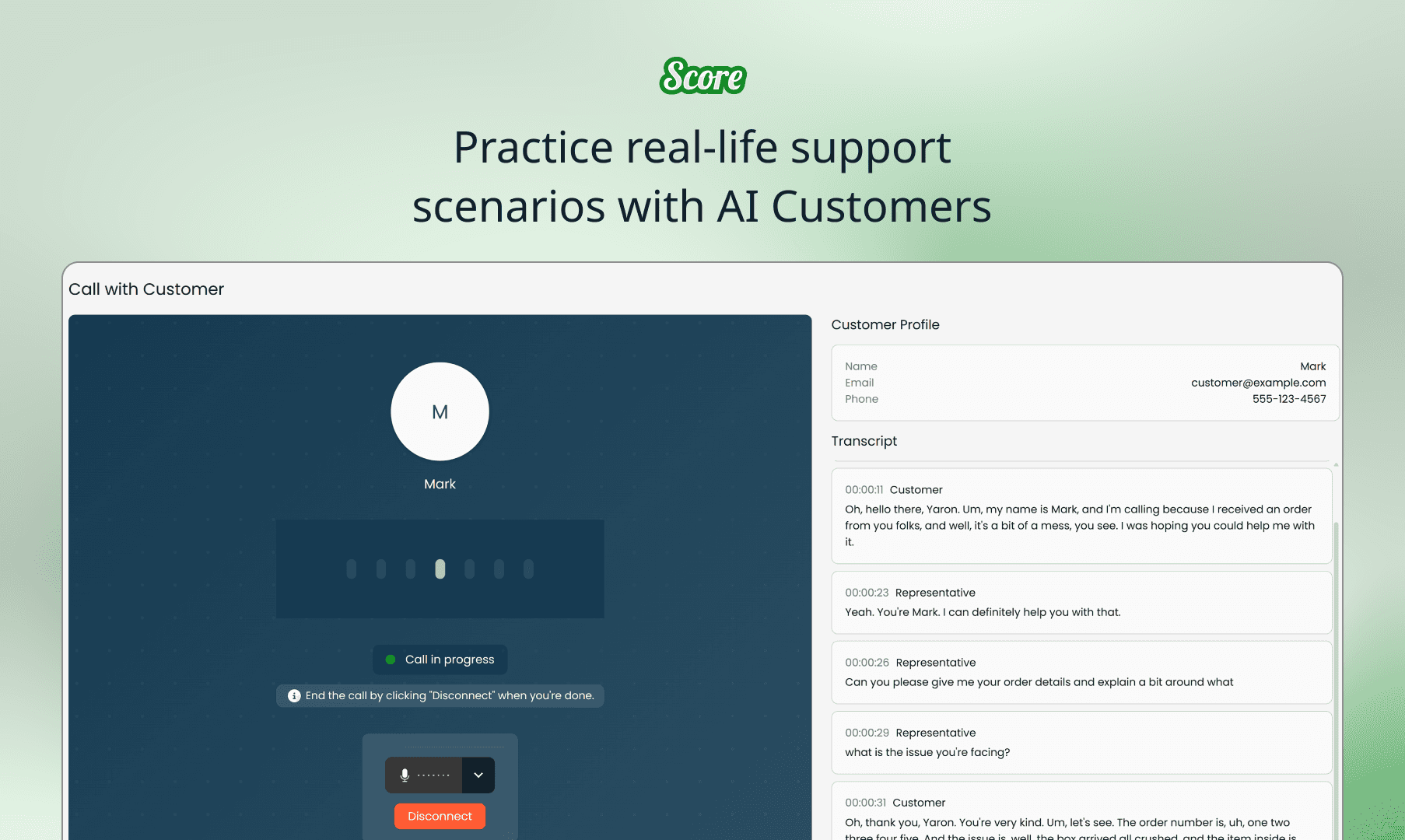
AI Roleplays by Score AI allows your agents to rehearse high-stakes customer interactions with AI-driven personas. It’s a flight simulator for customer service.
1. Simulate the "Spicy" Conversations
Not every customer is polite. Our AI personas can mimic a wide range of moods, objections, and service situations. Whether it’s an angry billing dispute or a complex technical troubleshooting session, agents can practice their de-escalation skills and "rehearse" their responses until they become second nature.
One of the biggest pain points in customer support is handling unpredictable customer behavior.
Customers may be:
Frustrated
Confused
Impatient
Skeptical
Demanding refunds
Challenging policies
AI Roleplays simulates these real-world interactions using AI-powered customer personas that mimic different moods and service situations.
Agents can practice:
De-escalation techniques
Handling objections
Delivering bad news
Explaining policies clearly
Showing empathy under pressure
This repetition builds muscle memory. And muscle memory builds confidence.
Instead of freezing during a live conversation, agents respond with clarity and control.
2. Training Grounded in Your Reality
Generic roleplays are forgettable. Score AI allows you to craft scenarios based on actual conversations and specific workflows within your helpdesk. This means agents aren't practicing for a hypothetical world, they’re practicing for your brand, your product, and your customers.
With AI Roleplays, simulations can be crafted from:
Actual past customer conversations
Real QA findings
Specific internal workflows
Recurring support cases
This ensures practice isn’t theoretical, but it’s directly aligned with how your team engages customers daily.
That relevance makes training meaningful. Agents aren’t just practicing; they’re rehearsing situations they will truly encounter.
3. Faster Ramping, Less Anxiety
New hire anxiety is a major contributor to early attrition. They often struggle with confidence during their first 30–60 days.
They worry about:
Saying the wrong thing
Escalating unnecessarily
Damaging customer relationships
Receiving poor QA scores
AI Roleplays creates a safe training ground where mistakes are learning opportunities and not customer-facing failures.
By providing a risk-free environment where it’s okay to fail, agents build muscle memory and confidence. They reach "floor-ready" status faster, reducing the time-to-productivity for your entire team.
By simulating high-frequency support situations early in onboarding, agents:
Gain exposure faster
Learn patterns quicker
Build response frameworks
Develop emotional resilience
This reduces ramp time and accelerates readiness.
For managers, that means:
Faster productivity
Lower onboarding strain
More predictable performance
4. Close the Loop: From QA to Coaching
This is where the magic happens. Because Score AI continuously audits your real-world interactions, the platform knows exactly where each agent struggles. Managers can:
Identify specific skill gaps
Assign customized roleplays
Track improvement over time
Example Workflows:
Low empathy score? Assign empathy-focused scenarios.
Struggling with policy explanations? Assign structured objection-handling practice.
Escalating too quickly? Simulate complex resolution paths.
This moves coaching from general feedback to precision development.
Instead of saying “improve your tone,” managers can say, “Complete this targeted roleplay and we’ll review your progress.”
That level of specificity transforms coaching from subjective to strategic.
From Passive Learning to Active Mastery
The difference between a "good" agent and a "great" one is often just a matter of repetition. But until now, that repetition came at a high cost of manager time and customer patience.
Poorly trained agents can lead to:
Lower CSAT scores
Higher churn
Increased escalations
Burnout
Attrition
By proactively strengthening skills, Score's AI Roleplays helps organizations:
Improve first-contact resolution
Increase customer satisfaction
Reduce escalation rates
Shorten onboarding cycles
Build stronger, more confident teams
When agents feel prepared, customers feel supported.
AI Roleplays changes the math. It offers:
For Agents: A safe space to fail, learn, and grow.
For Managers: Visibility into skill development without the manual overhead.
For the Business: Higher CSAT scores and a more resilient, confident workforce.
Stop hoping your agents will handle the next crisis well. Give them the tools to practice for it.
Frequently Asked Questions (FAQs)
1. How is AI Roleplays different from traditional training sessions?
Traditional sessions rely on manual facilitation and limited time. AI Roleplays offers on-demand, scalable, realistic simulations with structured feedback.
2. Can roleplays be customized to our specific workflows?
Yes. Scenarios can be crafted from actual conversations and internal workflows, ensuring relevance to your team’s operations.
3. Does this replace QA coaching?
No, it enhances it. QA identifies improvement areas, and AI Roleplays provides structured practice to address them.
4. Is this useful for experienced agents?
Absolutely. Even senior agents benefit from targeted practice in areas where performance data reveals improvement opportunities.
5. How does this help reduce ramp time?
New hires gain exposure to real customer challenges before going live, accelerating readiness and boosting confidence.
6. How does management track improvement?
Because Score AI continuously audits interactions, managers can assign roleplays and monitor measurable skill progression over time.
Ready to see AI Roleplays in action?
We’d love to show you how this feature can integrate with your existing QA data to create a high-performance coaching loop. Feel free to pick a slot here.