Insights
February 5, 2026
Ending Inconsistent Call Reviews: How Teams Finally Align on Quality Scoring

Varun Arora
In customer support and sales operations, one challenge quietly drains time, trust, and performance: inconsistent conversation scoring.
Two managers can listen to the same call, read the same chat, and still walk away with completely different evaluations. One hears empathy; another hears policy violations. One sees a “great save,” another sees a “missed opportunity.”
This inconsistency doesn’t just frustrate managers; it confuses agents, weakens coaching, and undermines the credibility of quality programs.
At Score AI we are addressing this problem by focusing on alignment first, not automation alone. Instead of asking teams to blindly trust AI or endlessly debate scorecards, the industry is shifting toward shared calibration, where people and AI learn to agree before decisions are finalized.
This article explores the real pain points behind subjective audits, why traditional QA processes fail to scale, and how group alignment between managers and AI finally brings fairness, clarity, and trust back into conversation reviews.
The Real Cost of Subjective Quality Audits
Quality assurance was designed to improve performance. Ironically, when scoring is subjective, it often does the opposite.
Managers See Different “Truths”
Even with a detailed scorecard, parameters like tone, empathy, objection handling, or confidence are deeply interpretive. One manager may score generously, another conservatively—both believing they are correct.
Agents Lose Trust
When agents receive conflicting feedback from different reviewers, they stop focusing on improvement and start questioning fairness. Over time, QA becomes something to “survive” instead of something to learn from.
Coaching Becomes Ineffective
If managers don’t agree on what “good” looks like, coaching sessions lack consistency. Agents improve in one direction, only to be corrected in the next review cycle.
Leadership Loses Visibility
When scores vary by reviewer, leaders can’t trust reports. Performance trends become distorted, making it harder to spot real issues or top performers.
Why Traditional QA Models Break at Scale
Many teams try to solve inconsistency with more rules, longer scorecards, or additional training. Unfortunately, these approaches often add complexity without solving the core issue.
Traditional Approach | Why It Fails |
|---|---|
More QA guidelines | Still interpreted differently |
Periodic manager training | Alignment fades over time |
Random audit spot-checks | Too limited to standardize |
AI-only scoring | Lacks human consensus if unaligned |
The problem isn’t effort it’s lack of shared calibration.
The Alignment Gap Between Humans and AI
AI-based conversation scoring promised objectivity and scale. And while AI excels at consistency, it introduces a new challenge:
What if managers don’t agree with the AI?
Without alignment:
Managers override AI results inconsistently
Agents distrust automated scores
AI insights are ignored or underused
The real breakthrough happens when managers align with each other first—and then align with AI.
Why Calibration is the most used Score AI feature
Score AI has a built-in group calibration module that tackles the root problem: everyone needs to agree on what “correct” looks like before scoring matters.
Instead of isolated reviews, managers evaluate the same conversations together, compare results, and discuss differences openly. This process transforms subjective opinions into shared standards.
What Group Calibration Solves
Eliminates reviewer bias
Standardizes interpretation of soft skills
Creates a single source of truth
Builds trust in AI-assisted scoring
Most importantly, it ensures that AI is judged against a human-aligned benchmark, not against individual opinions.
The Foundation of a Group Calibration Session
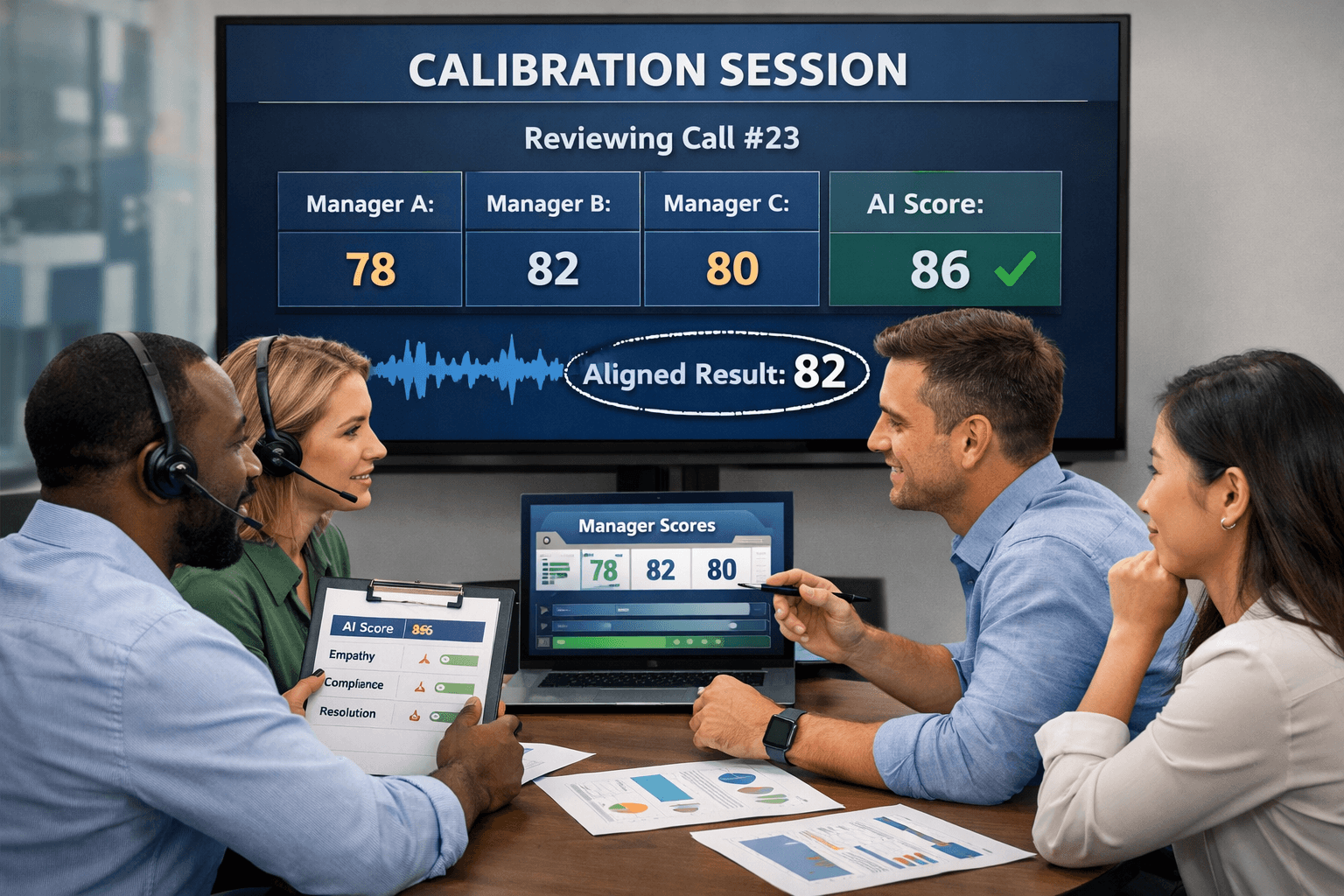
A group calibration session starts with a simple but critical goal: ensuring that every reviewer is assessing the same conversation using the same standards.
Rather than reviewing calls in isolation, managers come together to evaluate a shared set of conversations. This creates a controlled environment where alignment can happen deliberately instead of by chance.
Managers Review the Same Conversation
Each manager begins by independently auditing the exact same conversation using the existing scorecard and criteria. At this stage, reviewers are not trying to align yet—they are capturing their honest assessments based on how they would normally evaluate performance.
This step is essential because it reflects real-world scoring behavior and surfaces how each manager currently interprets the parameters.
Differences Are Made Visible
Once individual reviews are completed, the results are compared side by side. Score gaps, mismatched parameter ratings, and conflicting pass/fail decisions are clearly exposed.
Instead of hiding disagreement, the session is designed to highlight it. These differences reveal where subjectivity exists, where definitions may be unclear, and where expectations are being applied inconsistently across reviewers.
Standards Are Benchmarked Through Discussion
With discrepancies visible, managers discuss the reasoning behind their scores. The focus is not on defending individual judgments, but on clarifying intent:
What behavior should qualify as meeting the standard?
Where is the line between acceptable and exceptional?
How should edge cases be handled consistently?
Through these conversations, teams move from individual interpretation to shared agreement. By the end of this step, managers are no longer scoring based on personal judgment—they are scoring based on a collectively understood standard.
This alignment sets the foundation for everything that follows in the calibration process, including meaningful comparison with AI audit results and the selection of a final, agreed-upon outcome.
Aligning AI With the Team (Not the Other Way Around)
Once managers reach consensus, AI audit results are brought into the conversation.
This step answers critical questions:
Does AI interpret parameters the same way humans do?
Where does AI over-score or under-score?
Which metrics are fully aligned and which need refinement?
When AI results match the agreed-upon human audit, confidence skyrockets. When they don’t, teams have clarity on what needs adjustment.
One Final Audit, Everyone Agrees On
The most powerful outcome of group calibration is a single, final audit that:
Reflects internal manager alignment
Matches agreed AI logic
Becomes the benchmark for coaching and reporting
From that point on, comparisons are meaningful. Teams can confidently measure:
AI performance vs. the agreed standard
Agent improvement over time
Manager consistency across teams
What This Means for Agents
Agents feel the impact immediately.
Feedback becomes predictable and fair
Coaching aligns with actual expectations
Trust in QA increases
Performance goals feel achievable
Instead of asking, “Which manager reviewed this?”, agents ask, “How can I improve this skill?”
What This Means for Leadership
For leaders, alignment unlocks clarity.
Scores are comparable across teams
Performance trends become reliable
AI adoption feels safe and explainable
Scaling QA no longer increases inconsistency
Decisions become data-driven—not debate-driven.
FAQs
Why do managers score the same conversation differently?
Because many quality parameters—like tone, empathy, or confidence—are inherently subjective and influenced by personal experience and bias.
Can AI fully eliminate subjectivity in audits?
AI provides consistency, but without human alignment, it can still conflict with expectations. Alignment must come before automation.
How often should teams calibrate?
High-performing teams calibrate regularly- monthly or quarterly- to maintain alignment as teams, products, and customers evolve.
Does calibration slow down QA processes?
Initially, it adds discussion time. Long-term, it saves time by reducing rework, disputes, and confusion.
What happens after managers and AI align?
Teams establish a single final audit standard that becomes the reference point for coaching, reporting, and performance tracking.
Is group calibration only for large teams?
No. Even small teams benefit, especially when scaling or introducing AI-driven audits.
Conclusion: Consistency Is the Foundation of Trust
Quality assurance isn’t just about scoring conversations- it’s about creating trust. Trust between managers. Trust between agents and leadership. Trust in AI-driven insights.
By focusing on shared understanding before final judgment, teams replace subjectivity with clarity. Group calibration ensures that everyone- humans and AI alike- are truly on the same page.
And when that happens, QA finally becomes what it was always meant to be: a tool for growth, not frustration.